.svg)
.png?width=155&height=63&name=LogoImg%20(1).png "LogoImg (1)")

By Holly R. Corcoran, CPA
Veterinarians are trained to diagnose before they treat. Tax planning should work the same way. You would not recommend a procedure simply because it worked well for another patient, and a tax strategy should not be selected simply because a colleague used it or someone promoted it online.
The right place to begin is with the basics: Is income being reported correctly? Is the practice operating under the right tax structure? Are available deductions and benefits being used? Once those areas are working well, higher-income veterinarians and practice owners may be ready to explore more advanced strategies.
The goal is not to chase deductions. It is to legally and thoughtfully keep more of what you earn, protect cash flow, and redirect tax dollars toward the practice, retirement, investments, or other goals that matter to you.
Start with the quick wins
Some tax-saving opportunities are relatively easy to identify. I call these foundational strategies. They may not sound exciting, but when several are used together and properly documented, they can create meaningful savings.
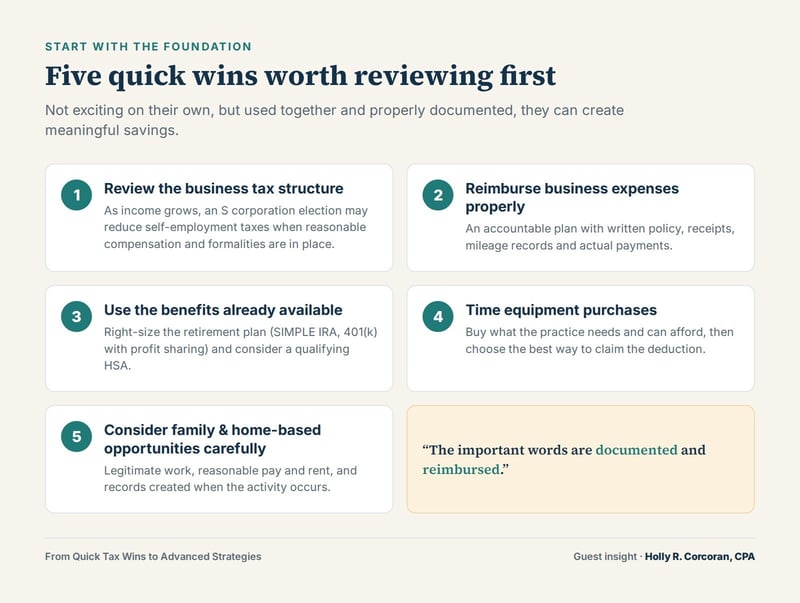
Review the business tax structure. A practice may begin as a single-member LLC filing on Schedule C and remain that way for years without anyone revisiting the decision. As income grows, an S corporation election may reduce self-employment taxes when the owner is paid reasonable compensation and the required payroll and corporate formalities are handled correctly. The LLC does not necessarily need to disappear; it may simply elect a different method of taxation.
Reimburse business expenses properly. An accountable plan allows the practice to reimburse an employee, including an owner-employee, for documented business expenses. Depending on the facts, that may include business mileage, continuing education, professional dues, supplies, or the business use of a home office. The practice receives the deduction, and a properly supported reimbursement is generally not taxable wages to the employee. The important words are documented and reimbursed. A written plan, receipts, mileage records, and actual payments matter along with any overpayments reimbursed to the company.
Use the benefits already available. Practice owners should review whether their retirement plan still fits the size, profitability, and goals of the practice. A SIMPLE IRA may be an excellent starting point, while a 401(k) with profit sharing may provide greater opportunities as the practice grows. Veterinarians employed by a hospital or university should look beyond the familiar 401(k) or 403(b) and ask whether other deferred-compensation or pension benefits are available. A qualifying health savings account can also provide a current deduction, tax-deferred growth, and tax-free withdrawals for qualified medical costs.
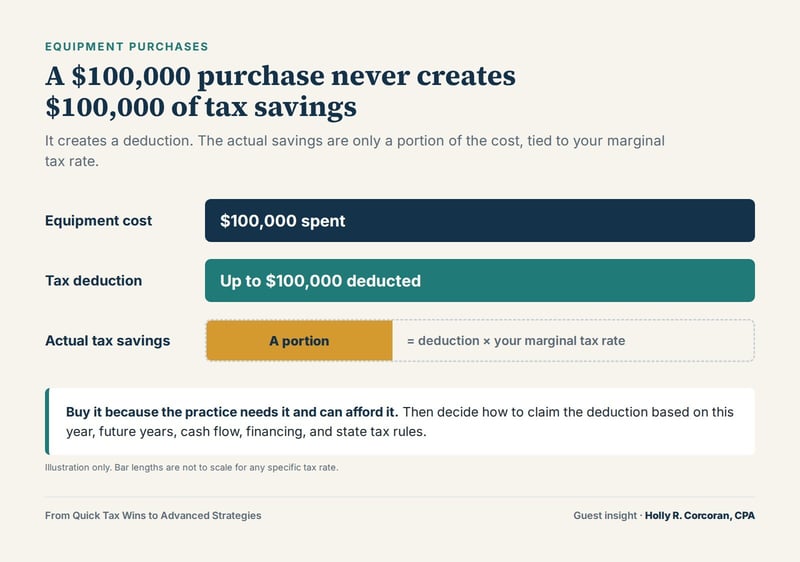
Time equipment purchases instead of buying a deduction. Accelerated depreciation may allow a practice to deduct qualifying equipment faster. But a $100,000 purchase never creates $100,000 of tax savings. It creates a deduction, and the actual savings are only a portion of the cost tied to the marginal tax rate. Buy the dental unit, ultrasound, truck, or other equipment because the practice needs it and can afford it. Then determine the best way to claim the deduction based on this year, future years, cash flow, financing, and state tax rules.
Consider family and home-based opportunities carefully. A practice may be able to pay children ages 7-17 for real, age-appropriate work or rent the owner's home for qualifying business meetings for a limited number of days. These provisions can be useful, but they are not casual write-offs. Services must be legitimate, compensation and rental rates must be reasonable, and the records should be created when the activity occurs not reconstructed after an IRS audit notice arrives.
When foundational planning reaches its limit
Traditional planning can be very effective, but it eventually plateaus. A veterinarian may maximize retirement contributions, use the available business deductions, and still owe a substantial amount because household income has continued to rise (if married filing jointly this rising income can come quickly in a professional family). That does not mean the return is wrong. It may mean the planning needs to become more sophisticated.
Advanced planning is not simply a bigger deduction. It often combines tax law, an investment or business activity, cash-flow analysis, participation requirements, legal documents, and multi-year reporting. Examples may include a cash-balance or defined-benefit retirement plan, a cost-segregation study for practice real estate, commercial energy credits with depreciation, equipment-leasing arrangements, oil and gas investments, or certain charitable strategies involving appreciated property.
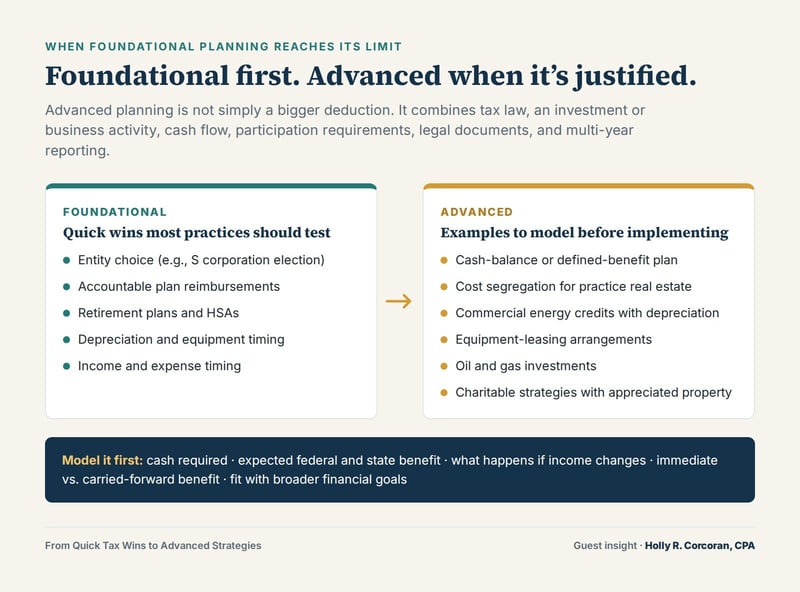
These strategies are not interchangeable. This is why advanced planning must be modeled before implementation. I want to know the cash required, the expected federal and state benefit, what happens if income changes, whether the benefit is immediate or carried forward, and how the strategy fits the veterinarian's broader financial goals. The best way to think about many of these opportunities is not as spending money to save taxes, but as redirecting dollars that otherwise would have gone to the IRS or state into an asset or strategy with potential long-term value. That redirection only makes sense when the expected result exceeds the cost and the risks are understood.
A simple planning process
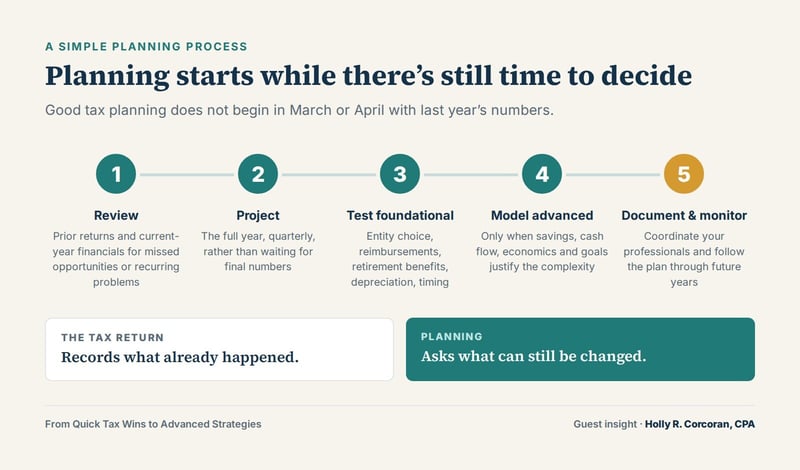
Good tax planning does not begin in March or April with last year's numbers. It begins while there is still time to make decisions. I generally recommend:
- Review the prior returns and current-year financial information for missed opportunities or recurring problems.
- Project the full year quarterly rather than waiting for the final numbers.
- Test foundational strategies first, including entity choice, reimbursements, retirement benefits, depreciation, and income or expense timing.
- Model advanced strategies only when the potential savings, cash flow, economics, and personal goals justify the added complexity.
- Document the decision, coordinate the professionals involved, and monitor the plan through the tax return and future years.
The real opportunity
The biggest tax mistake I see is not necessarily a missed deduction. It is the absence of ongoing planning. The tax return records what already happened. Planning asks what can still be changed.
For one veterinarian, the answer may be a mileage reimbursement and a better retirement plan. For another, it may be correcting the entity structure, planning a building purchase, or coordinating several advanced strategies on the individual return. The answer should reflect the veterinarian's income, practice, family, state, risk tolerance, and long-term plans.
My new book, The Veterinarian's Tax Advisor: How Veterinarians Legally Reduce Taxes and Keep More of What They Earn (scheduled for publication September 23, 2026) was written to help veterinarians understand these choices, recognize where opportunities may be hiding, and know when a more advanced planning approach is warranted. You do not need to become a tax expert. You simply need enough information to ask better questions and an advisor willing to help you look forward, not only backward.
Educational note: Tax rules change, and every taxpayer's facts are different. This article is educational and is not a substitute for individualized tax, legal, or investment advice.

Holly R. Corcoran, CPA, is the founder of Corcoran Business Advisory Services, LLC and author of The Veterinarian's Tax Advisor: How Veterinarians Legally Reduce Taxes and Keep More of What They Earn and The Vet Advisor: Are You Running Your Business Or Is It Running You. She helps veterinarians and practice owners reduce taxes legally, improve profitability, and make informed financial decisions through proactive tax planning. For more information, visit our website: https://cbas-cpa.com/